3. Import the HTML asset
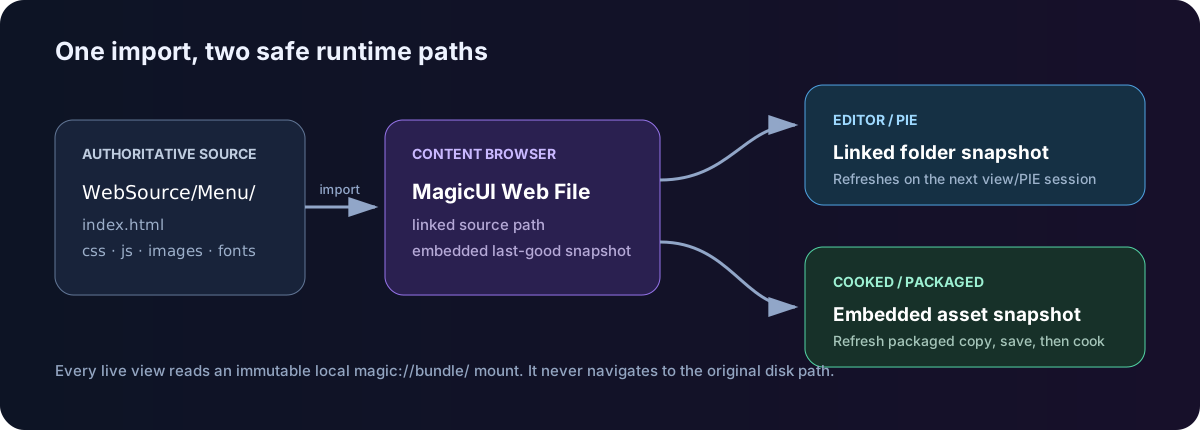
MagicUI's recommended content path starts with an Unreal asset. Importing the entry HTML creates a MagicUI Web File that remembers the source file and stores a cookable snapshot of its supported sibling resources.
Import index.html
- Return to Unreal Editor and make sure Play In Editor is stopped.
- In the Content Browser, create
/Game/MagicUI/Web. - Open File Explorer or Finder at
WebSource/GettingStarted. - Drag
index.htmlinto/Game/MagicUI/Web. - Wait for the import to finish.
- Rename the imported asset to
MWA_GettingStartedif you use Unreal naming prefixes.
The asset type should read MagicUI Web File. It is not a generic File Media Source, Text asset, or Unreal Web Browser asset.
Inspect the linked source
Double-click the asset. Its custom Details view shows:
| Field or action | What it means |
|---|---|
| Source File | The external index.html linked to this Unreal asset. |
| Status | Exists when Unreal can still find that source file. |
| External Editor | The application used by Open in External Editor. |
| Choose Editor… | Select VS Code, Rider, WebStorm, or another editor. |
| Use OS Default | Return to the operating system's file association. |
| Open in External Editor | Edit the authoritative file on disk. |
| Reveal in File Explorer | Locate the source file or its directory. |
| Refresh Packaged Copy | Update the embedded last-good snapshot used for cooking. |
The asset also tracks its source filename, type, and bundled file count. The first all-in-one example normally has one bundled file.
Understand what was imported
For an HTML entry asset, MagicUI recursively collects supported files from the
HTML file's entire directory—not only files discovered by parsing <link> and
<script> tags. That is why each UI should have a clean source folder.
WebSource/GettingStarted/   ← one page-specific source root
├── index.html              ← imported entry point
├── css/main.css            ← bundled automatically
├── js/app.js               ← bundled automatically
└── images/icon.png         ← bundled automatically
The complete extension and limit table is in Supported content.
The HTML asset matters in packaged games
HTML File Path and loose disk paths work only in Editor/PIE. A cooked or
packaged build needs the imported HTML MagicUI Web File. Do not defer
this import until packaging day.
Edit-and-test loop
Editor/PIE follows the linked source, but each play/view session receives an immutable snapshot. Use this loop:
- Stop PIE and make sure all live MagicUI views are gone.
- Edit and save HTML, CSS, JavaScript, images, or fonts on disk;
- start PIE again; and
- use Refresh Packaged Copy, then save the Unreal asset before a cook or source-control handoff.
Reload reloads the current session's page. It cannot replace that session's
frozen source bundle with a newly edited folder digest. Stop and start PIE for
source changes.
If the linked file moves
Use the Content Browser's standard Reimport With New File action and select the new entry file. Confirm the custom Details panel reports Status: Exists, refresh the packaged copy, and save the asset.